29 July 2022
Product cost doesn't exist
The organisation's cost does!
The profit on a sold product is traditionally calculated as the product's selling price minus the product cost.
While the selling price is fairly simple to calculate (even if, in some circumstances, it isn't that simple either), the problem is calculating the “cost”…
Product costing generally works bottom-up, summing the costs of single operations: basically, how much time each operation takes, multiplied by a “cost per hour”.
Let's assume that a certain operation (e.g. a machining operation) takes one hour to complete on equipment “X”.
The cost of the operator working on machine “X” for one hour is perhaps relatively easy to calculate (some operators cost much more than others, but fine: if you take an average, the error may not be that significant). But then, you know, a company has a lot of people who are not actually working on the part: a General Manager and all the other managers, the sales team, the planning team, accountants, HR, the receptionist and so on… so?
Then there is the equipment. Let's say it cost €1,000,000 and you “assume” (or hope, depending on your point of view) it will work for ten years. You would be tempted to say the hourly cost is:
€1,000,000 / 10 years / 230 working days / 24 hours a day = €18/h
That would be easy…
But the equipment sits in a shop, which is a building. There is an infrastructure of ancillary equipment (air compressors, forklifts, lifting equipment…), there is the heating system, there are maintenance people, there are consumables, there are manufacturing engineers trying to keep the machine running when it has issues, and so on… And, speaking of buildings, don't forget the one where the General Manager, the receptionist and the sales team have their offices, with all the related infrastructure.
So the “game” is to find a function that assigns a small share of your total expenses (including the gardener who cuts the grass, the sales team with their travel, fairs and dinners with customers, the receptionist and the phone bill, and so on…) to the cost of this one-hour operation.
Your controlling department ventures into a wild and dangerous forest of assumptions, averages, simplification ratios, similarities, multiplication factors and efficiency factors… In the end, after long and painful work seasoned with a generous dose of mental gymnastics and conjecture, you finally have your COST PER HOUR, and from there you can calculate the COST PER PIECE.
How reliable this result is, nobody knows. If someone uses one approach, the result is X; if someone else decides to treat an expense differently, the result is different.
It wouldn't be a problem if this number were taken for what it is: something that doesn't exist, only the result of a calculation based on assumptions and simplifications. It could be used, for example, for comparisons (between numbers calculated with the same assumptions and models), or to see whether it is rising or falling over the years.
But, unfortunately, something happens: everybody forgets that the cost per hour (used to calculate the cost per piece) doesn't really exist, and the number starts to be perceived as “the truth”, a real number.
The result is catastrophic. For example, someone might think that if the cycle time of a certain operation could be cut from one hour to 48 minutes, the cost of the operation would drop significantly (by 20%), and consequently the cost per piece, since the cost per piece is the sum of the costs of the single operations.
Is it true?
If I weigh a box on three scales and they give three different results, at least two of them end up in the bin.
I am an engineer: I don't rely on measurements that are not repeatable and reproducible.
The real world is what it is, regardless of the assumptions you make when you build a simplified model. The organisation (your company) has to pay the people who come to work every day, the rent, the materials and the services it buys. Exactly like you do.
These costs really exist! Product cost doesn't.
We can represent the company as a system where:
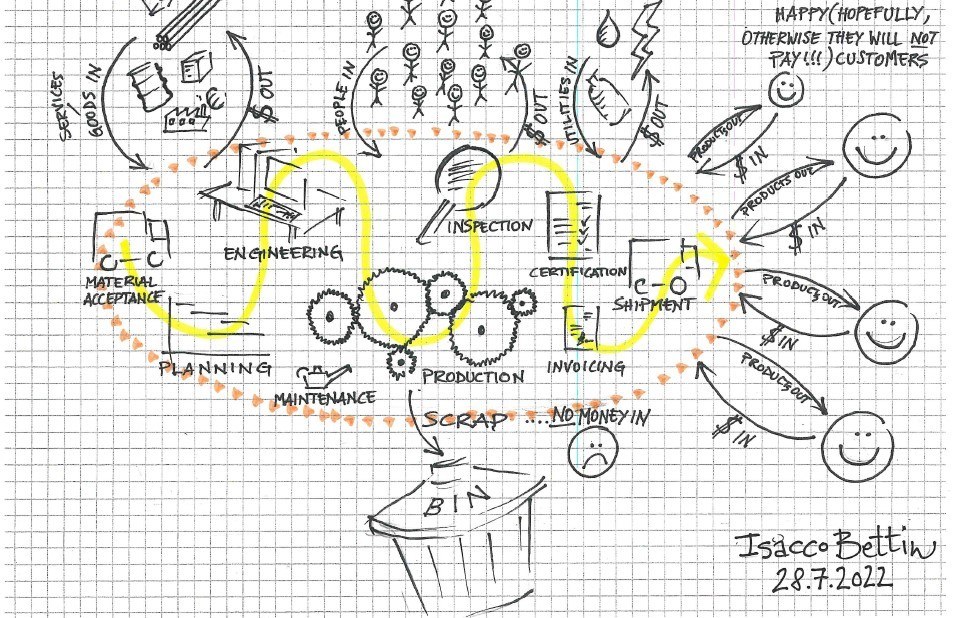
- people come in, money goes out;
- goods and services come in, money goes out;
- utilities come in, money goes out;
- finished products are sold to customers (please note: sold, not produced), money comes in;
- scrap goes in the bin, with no money coming in.
If the money you make selling products is more than the money you spend, good. Otherwise you are in trouble. Very simple.
This means that if you want to increase your margin, there are only a few options:
- sell the same number of products at a higher price (with the same people, buying the same goods and services and using the same utilities);
- sell the same number of pieces at the same price using fewer people (which means letting someone go, or not replacing someone who leaves);
- sell more pieces with the same people (if the market is willing to buy more from you);
- sell the same pieces buying fewer goods and services, or negotiating lower prices for them;
- produce less scrap;
- use fewer utilities to produce the same pieces.
On the other hand, if you fire your GM and hire one who costs twice as much, your organisation's costs increase. If you can't sell at higher prices or sell more pieces, or reduce the quantity or price of the goods and services you use, your margin will inexorably shrink. (Ask your accountants how they would account in the product cost for a GM costing €500k a year instead of the previous one costing €250k: you'll see whether they can answer!)
Now the point is: if you reduce the process time of a certain operation from 60 to 48 minutes, are you really increasing your margins? In other words, is the cost actually reduced? The answer is simple:
- if this allows you to sell (not produce!) more pieces at the same price, yes;
- if it allows you to release people from the company (remember, we are talking about the whole company here), yes;
- if, by doing so, you buy fewer goods and services or use less power, yes.
This means that if the improvement doesn't increase the productivity of the whole system (not just the machine we are looking at), or you can't release people from the company… your cost will stay the same.
And be careful, because if, as a result of this “improvement”…
- you use more consumables…
- you overload your equipment…
- you scrap more pieces…
…then your costs will increase rather than decrease!
In other words: if the operation was THE bottleneck of your whole system (from material receipt to product sold, including everything within your company's value stream), improving its cycle time will have an extremely significant impact on cost. Otherwise, if it wasn't the bottleneck, in the best case the improvement will have no impact at all, and in the worst case the “improvement” will only increase costs.
Remember that the company is a system: it is only as strong as its weakest link.
Remember too that every system has only ONE bottleneck! So if you improve a process just because you see some “potential”, statistically you are probably not focusing on your bottleneck.
Focus on what you really have to focus on!