From LinkedIn
Correlation does not imply causation
We often see relationships between two variables where, whenever one changes, the other is likely to change too. This is called "correlation".
In some circumstances it is an extremely powerful way to understand phenomena, but we must always remember that correlation does not imply causation!
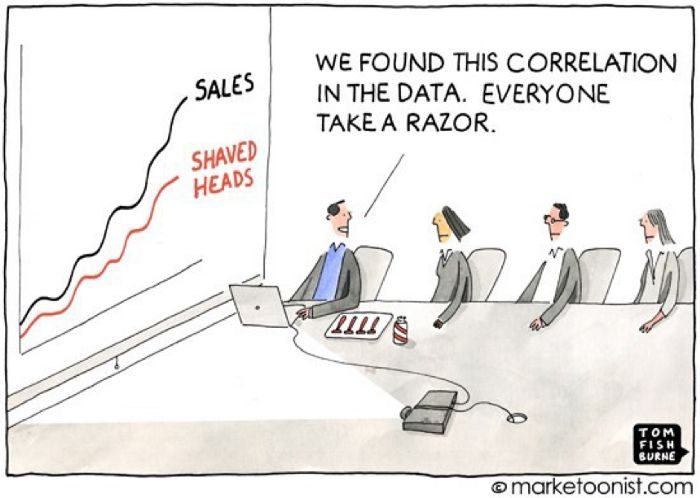
There are plenty of famous examples of so-called "spurious" correlations. Demographic data from 1999 to 2009 show, for instance, that the number of suicides by hanging, strangulation and suffocation in the US correlates extremely well (99.4%!) with the number of lawyers in North Carolina. Are the lawyers somehow responsible for the suicides, or are the suicides responsible for the growing number of lawyers working in North Carolina?
Again: over the last 40 years, CO2 emissions have correlated extremely well with average Body Mass Index (both growing exponentially). Is it CO2 that makes us fat, or are overweight people responsible for these CO2 emissions?
Last example: several studies show strong correlations between time spent playing violent video games and aggressive behaviour in adolescents. Do violent video games really promote aggressive behaviour?
The first two examples were clearly extreme, but I wouldn't be surprised if your brain switched to a completely different mindset when you read the last one. You probably thought: yes, violent video games promote aggressive behaviour.
But couldn't it also be the other way round, that adolescents with aggressive behaviour tend to play more violent video games? Or could both (aggressive behaviour and time spent playing violent video games) be growing because of a third, common cause?
I personally don't know.
What I do know is that we must always keep in mind that, faced with complicated and confusing data, the human brain desperately looks for a shortcut to reach a solution using as little energy as possible. So we are constantly affected by cognitive biases, simplifications, assumptions and irrational thinking patterns that often lead to faulty conclusions.
Nowadays, with all the data available and easy to combine (perhaps using AI, which will automatically find tons of these relationships), and with "data-driven decisions" as the mantra for running businesses, the trap is lurking more than ever.
Don't get fooled: pay attention!