3 February 2022
OEE: handle with care!

OEE (Overall Equipment Effectiveness) is one of the most widely used KPIs (Key Performance Indicators) in manufacturing companies: you often see it walking along the shop floor, displayed on boards and showcases that show daily, weekly and monthly OEE performance.
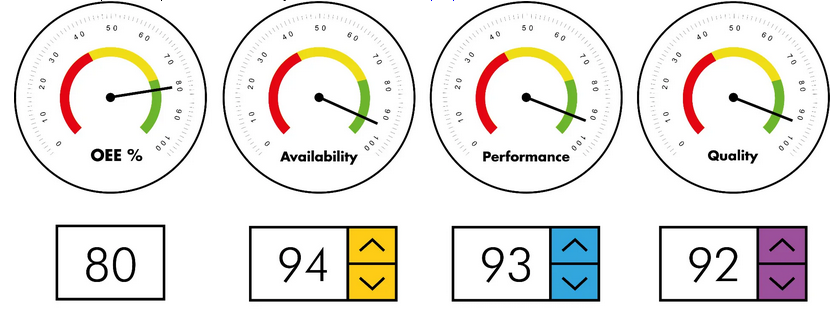
Sometimes you also see monitors next to the work centres, or big shiny dashboards (generally with a lot of yellow and red, and a few green spots) showing performance in real time.
If real-time OEE is expensive and completely useless (I will explain why separately; in the meantime, please don't do it!), OEE obsession can also be extremely dangerous for your plant and your company. This KPI should be used consciously and with a certain level of scepticism.
What is OEE?
OEE is a measure of how well the equipment in a plant is utilised in relation to its full potential. It was conceived to quickly identify the areas contributing to big productivity losses, including breakdowns, long setups, frequent stops and defective output.
The formula is simple:
OEE = Availability × Performance × Quality
The result is generally written as a percentage, always below 100%, that basically says how many good pieces you have produced on a certain work centre compared to the maximum quantity you could have produced in ideal conditions.
(If your OEE doesn't work like that, maybe there is something wrong in your calculation.)
So OEE is a really simple formula that puts together three good, solid metrics:
- Availability: was the machine producing pieces 100% of the time, or was it idle, stopped, broken or being set up? If, for example, you have a one-hour setup, then the machine works for 6.5 hours without breakdowns or stops, but then your operator has to refill the lubricant and stops the machine for 30 minutes, your availability is 6.5/8 = 81%.
- Performance: a performance of 1 means that your working cycle takes exactly the nominal time to produce a piece. If you slow down the cutting speed to avoid a tool breakage, or you have to stop the process for an inspection because you are not sure of its capability, this coefficient goes below 100%. If your cycle takes 23 minutes against a nominal time of 18, your performance is 18/23 = 78%.
- Quality: if you scrap 5 parts out of 100 (or simply 5 parts need to be reworked or corrected afterwards), your quality is 95%.
Good: with the numbers I've used, the OEE of this work centre would be:
OEE = 81% × 78% × 95% = 60%
This means that in the end you make 60 good pieces when you could theoretically have made 100.
You have just realised that a specific piece of equipment is being used far below its full potential.
Easy!
Now the question is: are you happy with this performance? Are you going to do something to improve the process? Are you going to do something to improve your overall efficiency?
And here is the crucial point: what dangers could be lurking under such simplicity?
1. OEE does not relate to the company's true business goals
If the company gets paid to run machines at full capacity all day, OEE might be a good business metric. For example, if you run a company with only one piece of equipment making the product the market is happy to pay for (say, a power company with a Pelton turbine running), you might find that OEE relates to your bottom line.
That is not the reality for many manufacturers, because they have other business goals related to the factors that drive customers' buying decisions: schedule, price and cost, and quality. Your KPIs should be aligned with your business goals, and OEE is not.
2. OEE does not address the real constraints of production
If you read Eliyahu Goldratt's "The Goal" and his Theory of Constraints (TOC) principles, you will quickly understand (well, not that quickly: the novel is about 300 pages…) that the most important thing in manufacturing operations is to keep the plant running to a "drum beat" and to mitigate the risk of any constraint that could affect the plant's rhythm and choke the production rate. The Theory of Constraints is a holistic view that takes the entire plant into account. OEE focuses on the local optimisation of each work centre, but the goal is to optimise the entire production system.
OEE assumes that the goal is to keep every work centre busy and producing at 100% capacity all the time. However, in the context of the whole production system, every work centre that is not the bottleneck should work at a low utilisation factor: if you produce faster than your bottleneck can process, you are working for nothing, because you are only filling the warehouse with pieces waiting to be processed. If you focus your efforts on increasing the productivity of a non-bottleneck, you are wasting time and money, because your system will not be able to exploit any advantage.
The goal is not to keep every work centre and piece of equipment busy all the time; the real goal is to get product out on time to match demand, at low cost and with high quality. An organisation's metrics should be directly related to the real business goals that lead to the ultimate goal of most manufacturers: higher profits.
If the organisation focuses on "fixing" the work centres with the lowest OEE, it might end up under-optimising the overall manufacturing process.
3. OEE is an aggregate metric that can obscure instead of clarify
Aggregate measures like OEE risk hiding the underlying issues. Each component of OEE on its own (availability, performance and quality) gives better visibility into the organisation's performance. When the sub-metrics are multiplied together, as OEE does, the resulting number can end up hiding the areas with the most problems (as "averages" do, but I will discuss that separately). For example, an area might have high availability and performance but low quality: because all the numbers are multiplied together, the low quality is hidden and therefore not addressed.
Not only does OEE hide underlying issues, it also muddies the waters when it comes to deciding where to improve. OEE assumes that each sub-metric is equally important, but for many organisations a 1% performance loss is not as important as a 1% quality loss. For example, it is easy to increase quality by increasing cost; the trick is to increase quality while reducing cost. An area with 90% quality and 70% performance has a different problem from an area with 70% quality and 90% performance, yet both can have the same OEE. Better to look at the quality factor alone than at OEE.
When you have a quality issue, you are not only throwing in the bin the work done on that piece at that specific work centre: you are throwing away the materials you bought and all the effort your colleagues put into the previous operations.
In summary
Stop being obsessed with OEE: OEE matters only for your bottleneck. By definition there is only ONE bottleneck in your system, and I mean the system end to end, customer to customer: from the customer who calls you for a quote to the invoice for the goods you sell. Work on the bottleneck, increase its capacity and measure the improvement using OEE as the main KPI.
What about all the other processes?
Forget OEE and, after you have improved your bottleneck's performance (after, not in parallel!), focus your efforts on improving quality.
Will OEE still show very low values? Who cares?