17 December 2021
"Perfect" processes with "normal" people
Every week I read many posts and articles describing people as the most important asset for a company's growth, but I have to say I only partly agree.
Don't get me wrong: people are important, yes. People are extremely important!
On the other hand, I can't believe that a company's fortune or failure depends mainly on its HR process. Selecting the best talent and keeping it motivated over a 40-year career is a big challenge, and a good HR process will certainly boost a company's growth, but it can't be the only critical success factor. Add the fact that every person is different, and it follows that there must be something else that makes one company an international market leader for decades and another one fail, even when the employees come from the same universities.
If I go to McDonald's for a burger, I would be surprised to have a particularly good burger on Monday and a particularly bad one on Thursday because the "chef" has changed. McDonald's burger preparation process is so strong and standardised that in Shanghai I can taste something very similar to the burger I would eat in New York (and if there are differences, they are there on purpose, carefully designed to suit local taste).
The same concept applies to other companies and markets. If I hire one of the Big Four for a consulting project, I would be really disappointed to see, halfway through, the quality of the service change because person "A" has been promoted and now I have person "B", who is not as good as "A"… or because "B" has decided to start again from the beginning because they have a different "style".
Again: if I buy a brand-new car and there is a problem with the turbocharger, I expect to go to my local dealer and find somebody who can fix it. I don't care if your master mechanic, the world's greatest turbocharger expert, is on holiday this week, or broke his leg and will be back in three months. I decided to buy a car from you: now I expect you to fix the problem today, whatever list of reasons "why not" you can come up with.
What does this mean? What is the main value on which a company's reputation and success are built?
The process leverage theory
I've developed a very simple theory, which I call the process leverage theory.
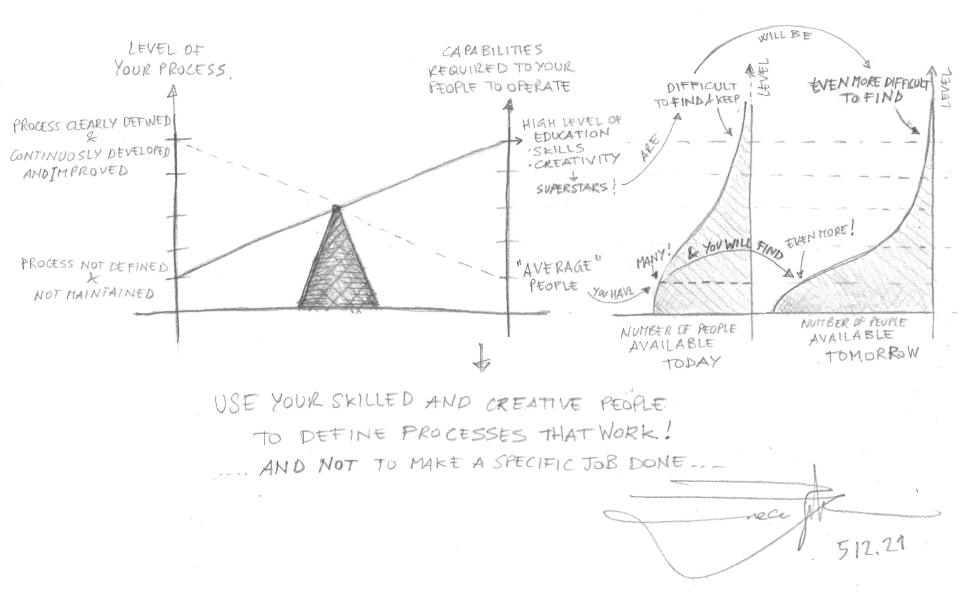
If your processes are poorly defined (incomplete, unclearly described, never reviewed for improvement), you will always need "superstars" to create value for your customer, that is, to get the job done. You need extremely creative people with great skills and experience, who by definition are very hard to find, keep and replace.
On the other hand, if you have high-quality processes (well defined, clear and periodically reviewed for improvement), even an "average" person can learn them quickly and work to them, delivering consistent results. IKEA's assembly instructions are so clear that an average person can build their own kitchen, even if it's the first time they've used a screwdriver.
Let's take an example, using a process that is core to most organisations.
You can simply tell your sales department: "Go and sell our products." Everyone will have to create their own "way": decide how to prepare the customer presentation, what the minimum acceptable margin is (it's impossible for a salesperson to accept that there is also a maximum acceptable margin, but that's another story!), which payment terms to offer, how to judge whether a delivery date is feasible, a formula for quantity discounts, and so on… Everyone also has to decide how to dress, and guess when it's better to call the customer and when it's worth visiting.
If you're lucky, sooner or later you find a "fantastic seller": he has created his own selling "style", based on the experience HE has gained over the years, and he consistently performs better than everyone else. When you ask him "How do you do it?", he answers "I just go and sell!" and runs off. One day one of your customers notices that he is really good and makes him an offer. Remember, he is a "fantastic seller": I'll let you imagine how painful (for you!) the negotiation could be now that he has an interesting alternative up his sleeve. He knows his value to the company better than you do, he knows he performs much better than the others, he knows that if he leaves it will be a disaster.
You can stick to Chuck Noll's "Everyone is important, no one is indispensable", but the reality is that if he leaves and you have no alternative as good as him, behind the appearance of "nothing will change" and "it will all be fine", you will suffer.
Or… you can raise his salary and bonus. If you are smart, you know it's only a matter of time: there is always somebody who offers more and, even more importantly, it's even worse if there isn't! I think you understand what I mean.
So in the end you have to decide whether you want your costs to increase or your sales to decrease. Either way, you won't solve your problem.
Why did it happen? What is the root cause?
In my opinion, the main problem is how performance is perceived, measured and managed. There is often a huge focus on getting the specific job done, then the next one, and so on. Companies always tend to deliver to the customer at the highest possible rate, sometimes forgetting that if the know-how (knowing how to deliver value) is not saved somewhere, this is a structural problem for the company's health. The problem is that people are rewarded for short-term performance: how much you produced this year, how much you sold, how many new products you developed, how much you saved in supplier negotiations…
What about the process? Did your people help improve how parts are produced, how customer contracts are closed, how new products are developed, how negotiations are conducted? Did they help make know-how, experience, mistakes and ideas explicit and build them into the process, so that the whole team can benefit? Or did they keep all their "secrets" to preserve their "competitive advantage" over their team mates? Has anybody measured this kind of performance at all?
In the end, any specific job has relatively little value to the company, while a process improvement can deliver higher performance for the whole team for many years. There is an order of magnitude of difference.
If you keep giving your best people the most difficult tasks and measure them on how well and how fast they achieve a specific result, you have a problem: they will try, fail (at the company's expense), and try again and again until they get the result. Along with their bonus, above all they gain experience and knowledge, which after a few years they will sell back to you (or to somebody else) at a significantly higher price.
Processes, the ones that contain all the know-how of all the people who have worked on them, are the real critical factors for a company to grow and flourish in the long run. If you build your company (and your performance management process) on this philosophy, people will come, make their contribution and then leave without creating any headaches!
A manager's responsibility is therefore to:
- define a process that creates value, starting from value stream mapping;
- ensure the process is followed in the same way by different people;
- ensure that people's ideas, failures and experiences are fed back into the process, to make it better month after month, year after year.
The result? Perfect processes with "normal" people!