From LinkedIn
Real-time OEE? No, thanks!
OEE (Overall Equipment Effectiveness) is probably the most widely used KPI in manufacturing companies: it is measured everywhere, over time intervals that get shorter year after year.
Today, in some places, OEE is measured in real time. Is it a good idea?
I'm not a big fan of OEE, because OEE basically just tells you how many parts you have produced compared to what you could have achieved in ideal conditions. So what?
Let's say your planning department planned on an 85% OEE, but you are running at 75%. So what? What do you do?
Unless you are one of those who think the solution is to walk around the shop floor shouting at the guys to "work harder!" (in that case real-time OEE might be useful: you would spend a lot of time in the gemba), if you want to improve your performance you have to understand what is happening.
OEE is an aggregate indicator, and aggregate indicators are useful only when everything is going well.
So if everything is going well (I mean cash flow, return on assets, margins… not OEE), you can use OEE, no problem. Otherwise OEE will not help you improve.
OEE is the product of three main factors:
- Availability: hours the machine was not broken / (hours not broken + hours broken)
- Speed: hours spent making parts / (hours spent making parts + hours spent not making parts)
- Quality: good parts / (good parts + scrapped parts)
These three factors start to get more interesting, don't they?
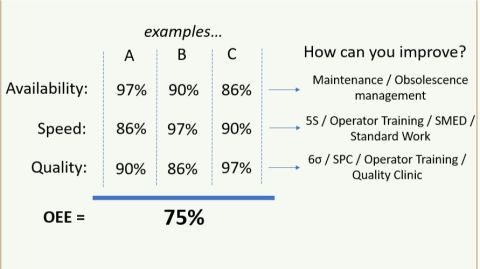
In the picture I've described three examples, all with an OEE of 75%. Do you see the differences?
I chose a 75% OEE on purpose: I know many operations and production managers who would be quite happy with this result.
Now look at availability, speed and quality… Would you still be so happy?
If you want to improve, what can you do? Depending on where you start, the improvement activities (and therefore the team and skills required) can be very different. But none of these improvements will be completed in ten minutes, or in an hour…
- Do you complete a Six Sigma project to improve process capability in a day?
- Do you define the standard work for your operators in an hour?
- Do you implement, in 30 minutes, a procedure that lets you change over in 10 minutes instead of 2 hours?
Unless there is a very obvious issue, no.
So why are you thinking of measuring OEE in real time?
If you really want to keep using OEE, better to also consider its three components separately, and to re-evaluate your performance over a time frame that allows the results of your improvement projects to show up (if you do nothing, things will get worse, not better).
Measuring OEE is like weighing yourself: doing it in real time is useless!
Question: where would you start to improve the situation in "example A"?